
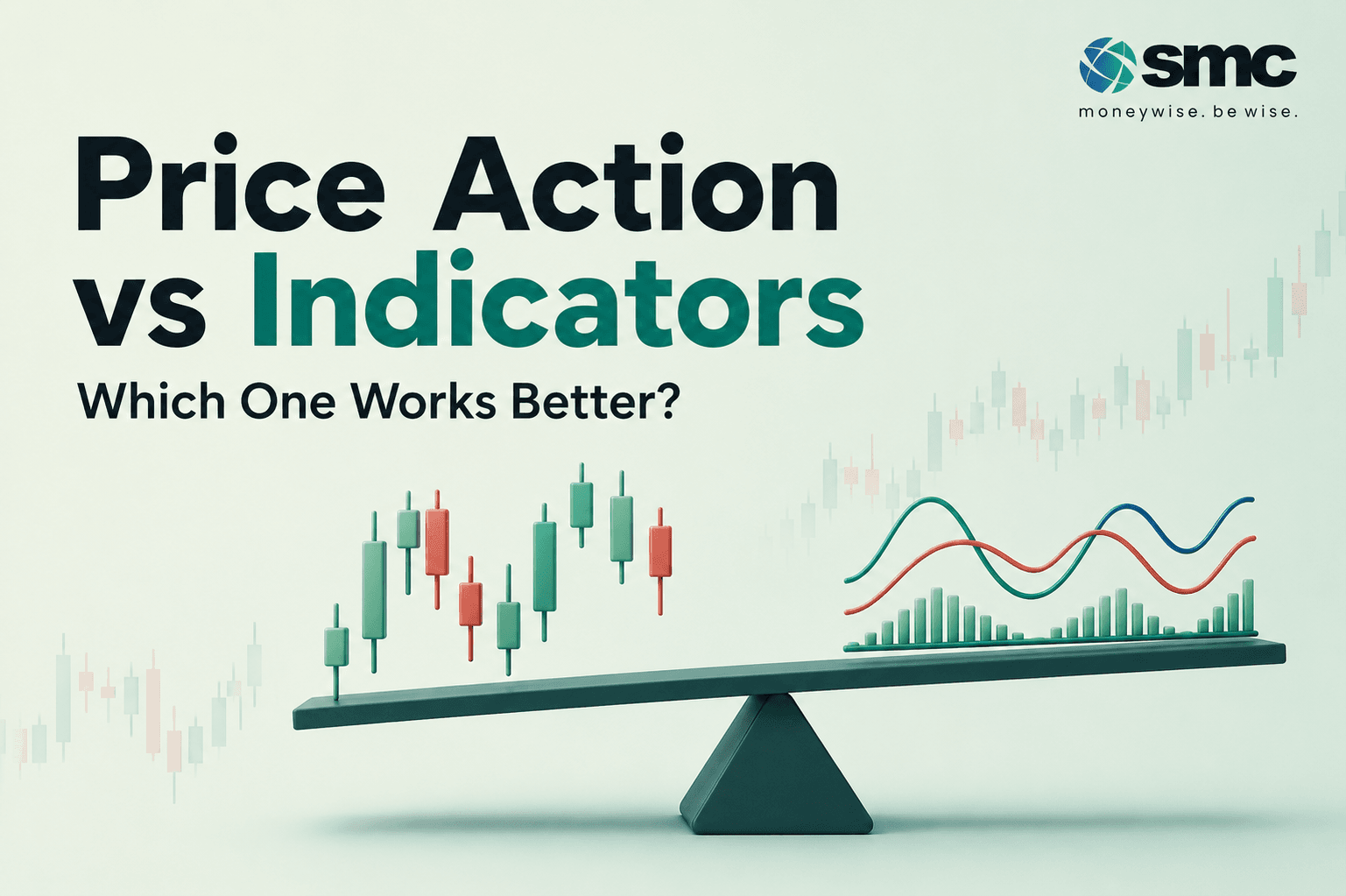


A common dilemma in trading is whether to rely on price action or indicators. The real issue is not which one is better, but how decisions are being made.
Both approaches use the same underlying data, price, and volume. The difference lies in how that data is interpreted. Price action reads raw market movement through structure, levels, and patterns. Indicators transform that same data into formulas and signals that are easier to standardise and repeat.
The trade-off is between flexibility and structure. Price action offers context and adaptability but requires experience to interpret correctly. Indicators provide clarity and rules, but can lag and oversimplify market conditions.
In practice, the choice is rarely binary. What matters is understanding the role each approach plays and how it fits into a consistent trading process.
#What Is Price Action Trading?
Price action trading bases decisions primarily on the raw movement of price over time, with minimal or no use of traditional technical indicators. Traders examine candlestick structures, swing highs and lows, chart patterns, support/resistance zones, and trendlines to infer the balance between buyers and sellers.
The core premise: all available information, fundamentals, sentiment, liquidity, and order flow are ultimately reflected in price. Studying the price itself should be sufficient to read market conditions.
#Core Principles
#Support and resistance
Levels where price repeatedly stalls or reverses, marking zones of concentrated buying or selling interest.
#Trends and market structure
Sequences of higher highs and higher lows (uptrend) or lower highs and lower lows (downtrend), plus structural shifts that may signal reversals.
#Candlestick patterns
Formations like pin bars, engulfing patterns, hammers, and shooting stars that suggest short-term rejection or continuation.
#Chart patterns
Larger structures (head-and-shoulders, triangles, flags, double tops/bottoms) that may precede breakouts or reversals.
#Price rejection
Wicks probing beyond key levels before reversing, often interpreted as failed breakouts or stop hunts.
#Volume as validation
Even "indicator-free" traders often use volume to confirm the strength of moves.
Price action is discretionary by default. Traders interpret patterns in real time, weighing broader trend, volatility regime, and news context rather than following a rigid formula. This gives flexibility but introduces subjectivity and the risk of inconsistent decision-making.
#Why Traders Choose Price Action
#Chart clarity
Removing most indicators reveals price and levels clearly, reducing cognitive overload.
#Real-time responsiveness
Traders interpret current candle behaviour directly rather than waiting for smoothed, lagged signals.
#Universality
Support/resistance, trends, and breakouts work across asset classes and timeframes.
#Focus on context
Encourages thinking in terms of liquidity, participants, and narrative.
Building skill in price action takes time because the edge lies in distinguishing meaningful structure from random noise in real time.
#What Are Trading Indicators?
Technical indicators are mathematical formulas applied to historical price (and sometimes volume) that output derived values, averages, oscillators, or bands.
They aim to highlight trend direction, momentum, volatility, or overbought/oversold conditions that may not be immediately obvious from raw charts.
#Major Categories
All indicators lag price to some degree because they use historical data. But they smooth noise and provide more objective, rule-based signals than purely discretionary chart reading.
#Why Traders Use Indicators
- #Objectivity: Thresholds and crossovers can be encoded into clear rules, reducing emotional decision-making.
- #Standardisation: Consistent signals across markets and timeframes, enabling systematic backtesting.
- #Noise filtering: Smoothing functions help traders avoid reacting to every tick.
- #Accessibility: Indicator rules are often easier for beginners to learn initially than interpreting nuanced price action.
The main risk is overloading charts with indicators, which leads to conflicting signals and slows decision-making instead of improving it.
#Key Differences Between Price Action and Indicators
#Data Source and Decision-Making Process
Both approaches start from the same inputs: historical OHLC and volume. The difference is in processing.
- Price action relies on visual and cognitive pattern recognition applied directly to candles and swings. Indicators apply explicit mathematical formulas and render results as lines, histograms, or bands.
- When traders interpret price action, they are performing similar transformations mentally, averaging recent highs/lows, inferring momentum from candle size, without plotting formulas. The real distinction is whether processing is #implicit and discretionary or #explicit and rules-based.
- Indicators lend themselves to rule-based trading ("buy when 50-day MA crosses above 200-day MA"). Price action can also be formalised (rules for pin bars at support with defined risk), but is more often practised as a discretionary craft where context and judgment dominate.
#Lag, Noise, and Signal Reliability
The claim that indicators "lag" while price action "leads" is common but oversimplified. Both are based on historical prices. Indicators make the lag explicit; price action patterns also form only after candles close and swings complete.
Complaints about indicator lag often reflect misuse (long lookback periods for short-term scalping) rather than inherent flaws. Conversely, price action's speed advantage demands significant experience to distinguish meaningful moves from random noise.
#Flexibility vs Rule-Based Trading
Price action is more #flexible and context-driven; traders can integrate macro news, intraday sentiment, and order flow. Discretionary traders change their interpretation based on the environment, treating the same pattern differently in a strong trend versus a range.
Indicator-based approaches are more naturally #rule-based; they enable systematic backtesting, reduce emotional interference, and scale across markets via automation. The trade-off: rigid rules can struggle to adapt to regime shifts or unusual events without periodic re-evaluation.
#Which Works Better for Different Types of Traders?
The better fit depends on experience, style, and personality.
#By Experience Level
#By Trading Style
- Scalpers and intraday traders often lean toward price action for speed, using key intraday levels and immediate candle behaviour, sometimes with a single indicator (VWAP or short MA) for directional bias.
- Swing traders frequently combine both daily/4H price action to define bias and zones, with moving averages, RSI, or MACD to time entries and exits.
- Position and trend-following traders rely more on lagging trend indicators (moving averages, trend filters) to stay with large moves, with less focus on granular candle patterns.
#By Personality
- Analytical, rules-driven traders prefer indicator-based or algorithmic strategies that can be defined, tested, and automated.
- Pattern recognition, visually oriented traders resonate more with price action and contextual interpretation.
- Traders sensitive to decision fatigue benefit from rule-based systems that reduce discretionary choice.
#Combining Price Action and Indicators Effectively
#Using Indicators as Confirmation Tools
Confluence, the alignment of multiple independent factors, produces stronger signals than any single method alone. The modern consensus approach:
- #Define the trade idea from price action: Trend direction, key levels, pattern at a significant zone.
- #Validate with one or two indicators: Check RSI for overbought/oversold at a support/resistance level, confirm trend direction with a moving average, or verify breakout strength with volume indicators.
Practical combinations that appear across trading education:
- Key level (support/resistance) + momentum confirmation (RSI or divergence)
- Trend filter (moving average) + price action entry in direction of trend
- Volatility bands + price pattern to confirm breakout or mean reversion
#Avoiding Conflicting Signals
Limit charts to one to three indicators serving distinct purposes, one trend filter, one momentum tool, and one volatility measure. Ensure indicators agree with the underlying price story rather than contradicting a clear structure. Avoid constant parameter tweaking to fit past data, which leads to curve fitting and poor out-of-sample performance.
For price action, formalise at least some rules (pattern criteria, invalidation levels, required context) to reduce hindsight bias and enable meaningful trade journaling.
#Building a Simple, Robust Trading System
Whether emphasis falls on price action, indicators, or both, the system-building framework is the same:
- #Define market and timeframe: Choose instruments aligned with available screen time and risk tolerance.
- #Specify directional bias: Use higher-timeframe price structure + simple trend filter (e.g., 50-day MA).
- #Define entry criteria: Limited price action conditions + one or two indicator confirmations.
- #Define exits and risk management: Price-based stops (beyond swing highs/lows) and ATR-based stop distances.
- #Backtest and forward-test: Track win rate, expectancy, drawdown, robustness across regimes.
- #Iterate cautiously: Adjust based on data, not hunches.
The goal is internal consistency and compatibility with the trader's personality and constraints, not finding a "perfect" combination.
Whether you trade using price action, indicators, or a combination of both, long-term success depends on consistency, discipline, and risk management. Build your trading journey with the right platform and tools, and open a free demat account.

 1800 11 0909
 smc.care@smctradeonline.com